Environmental sensing, occupancy prototype, MQTT/REST data access, and room-level integration tests.
Ceiling-mounted room intelligence
Roomor
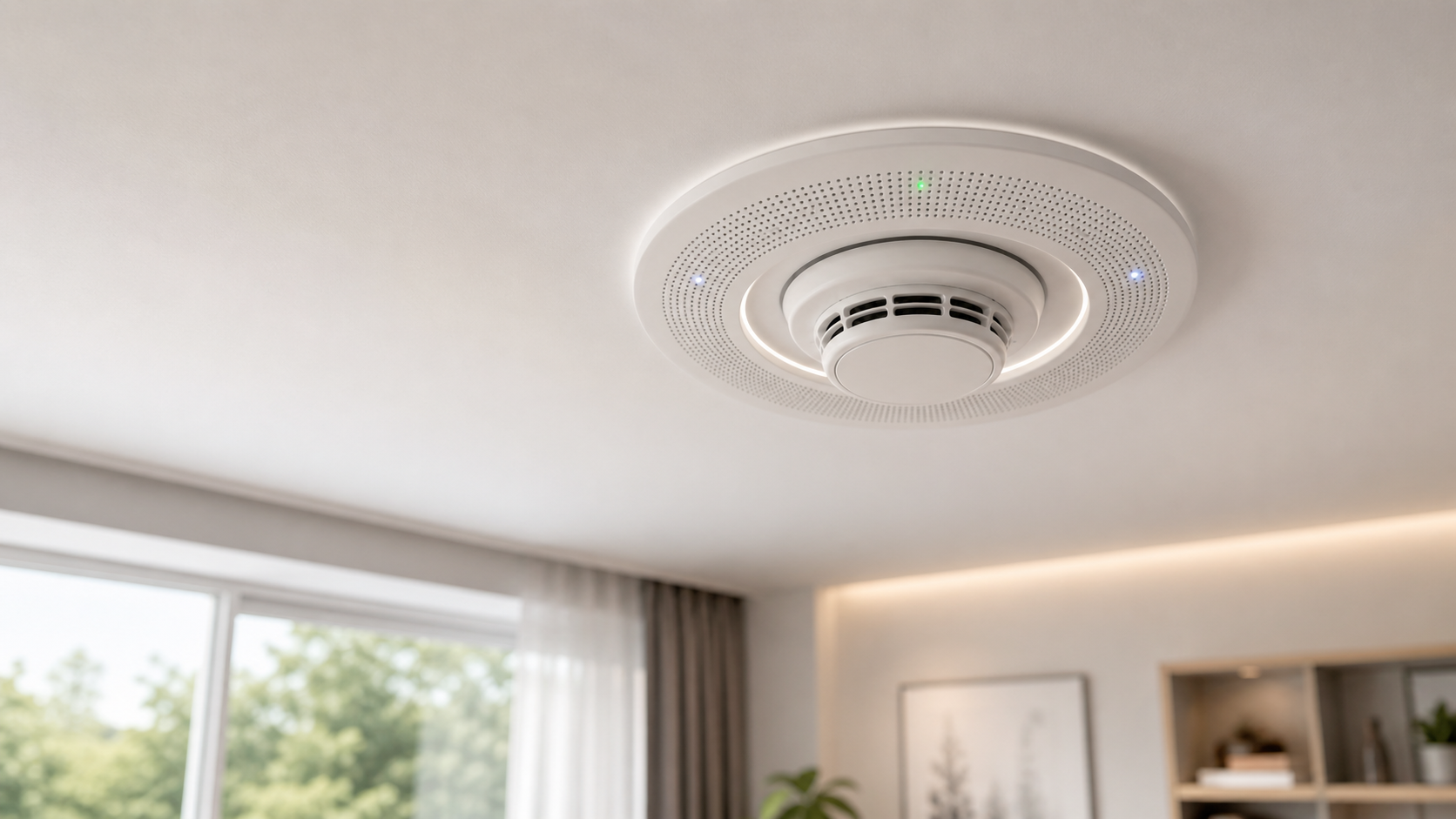
Room-level sensing for smarter HVAC, comfort, and occupancy intelligence, installed like a smoke detector.
The room becomes the control surface
A sensor hub that disappears into the ceiling.
Roomor replaces or pairs with a standard smoke detector mount and adds environmental, acoustic, optical, and radar sensing in the same familiar footprint. It reports raw values first, then evolves toward local preprocessing and room-level prediction.
Integrated smoke module, audio classification, advanced edge AI, and predictive multi-room optimization.
Designed for pilots
Start with rooms where comfort and energy matter.
Smart homes
Detect occupancy and air quality room by room, then adjust heating, cooling, blinds, and ventilation.
Hotels and offices
Understand space usage without cameras and reduce HVAC waste in rooms that are empty or underused.
HVAC integrators
Feed clean room signals into building control systems through MQTT, REST, Matter, or local processing.
Assisted living
Recognize presence, activity changes, and anomalies while preserving privacy through non-camera sensing.
Sensor stack
Everything needed to read a room.
Smoke and safety
Planned certified smoke detector interface in early versions, with future integration path into the housing.
Air and comfort
Temperature, pressure, humidity, CO2, and VOC sensing for comfort, air quality, and ventilation logic.
60/120 GHz radar
Occupancy, people count, posture, movement, and object classification without camera privacy concerns.
Stereo audio
Microphones localize sound sources and recognize appliance activity patterns when processing is enabled.
Light conditions
Ambient light and color temperature help coordinate blinds, lighting, glare, and daily rhythm cues.
Install awareness
Rotation, removal, and tamper detection through compact orientation sensing or a lower-cost equivalent.
Connectivity
Ready for modern smart-home and IoT networks.
Roomor is designed to connect to today's home automation ecosystems as well as technical IoT backends. It can use low-power mesh networks for long battery life, Wi-Fi for higher bandwidth, and open APIs for integration with local or cloud platforms.
Matter over Wi-Fi 6/7
Matter over Thread
Bluetooth LE 5.3
ZigBee 3.0
MQTT
REST API
Local interface
Easy to install, configurable when needed.
Everyday actions stay simple on the device, while advanced settings are available through a local web interface for installers, developers, or power users.
- Dedicated test button for the smoke detector function
- Physical power, reset, and system control button
- Captive Wi-Fi portal for first-time setup
- Embedded web settings for network, MQTT, REST, and diagnostics
Home orchestration
Every Roomor reports into one master brain.
Room sensing
1-second measurement intervals across comfort, safety, presence, sound, and light.
Roomor master
Combines room requests and coordinates shared systems like central heating or AC.
Actuation
Heating, cooling, blinds, airflow, windows, lighting, and alerts adapt to learned routines.
Power and installation
Long-life by design.
Roomor combines ultra-low-power sensing with configurable connectivity and optional indoor photovoltaic harvesting. It is designed to fit the same ceiling footprint as a smoke detector, making upgrades possible without drilling, rewiring, or changing the room.
Long-life operation
Designed for smoke-detector-class maintenance cycles
Flexible connectivity
Disable high-power radios when lifetime matters most
Drop-in upgrade
Fits the existing detector position and mounting concept
Processing models
Choose where room intelligence runs.
Private local processing
Roomor streams sensor values through MQTT or REST to a local master system for automation, storage, and analysis inside the home or building network.
On-device preprocessing
Roomor can classify occupancy, sound direction, appliance activity, and room states directly on the device before sending compact events or processed results.
Scalable intelligence
Optional cloud processing can combine multiple rooms, learn long-term patterns, detect anomalies, and optimize comfort and energy across the complete home.
Contact
Talk to us about pilot deployments.
Roomor is open for prototype discussions with smart-home partners, HVAC integrators, building operators, and assisted living technology teams.
Company
Benoli Tech
Email
hello@benolitech.com
Phone
+40 740 462 860
Address
Bd. Nicolae Balcescu nr 3, Bucharest, Romania
Request prototype discussion